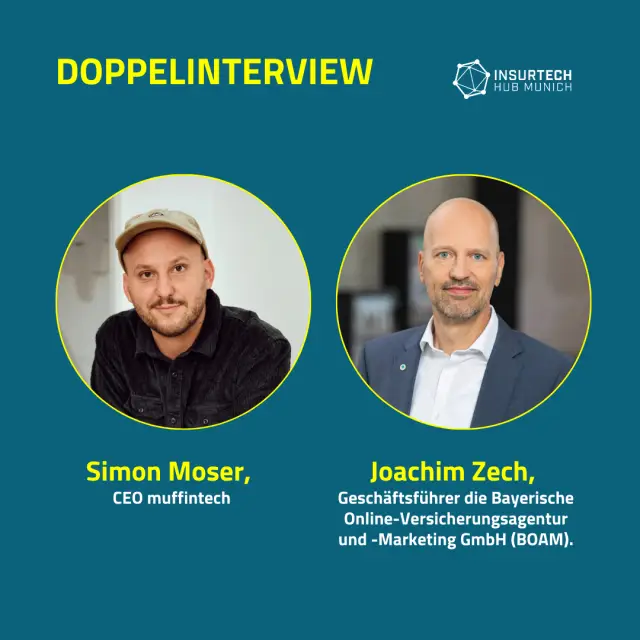
Bayerische and the start-up muffintech have developed "LEA," an AI assistant that actively guides interested parties through the application process—in a well-founded, understandable, and real-time manner. We talk to Simon Moser, CEO of muffintech, and Joachim Zech, Managing Director of Bayerische Online-Versicherungsagentur und -Marketing GmbH (BOAM), about how the partnership came about, the pilot project, and the role ITHM plays in promoting these partnerships.
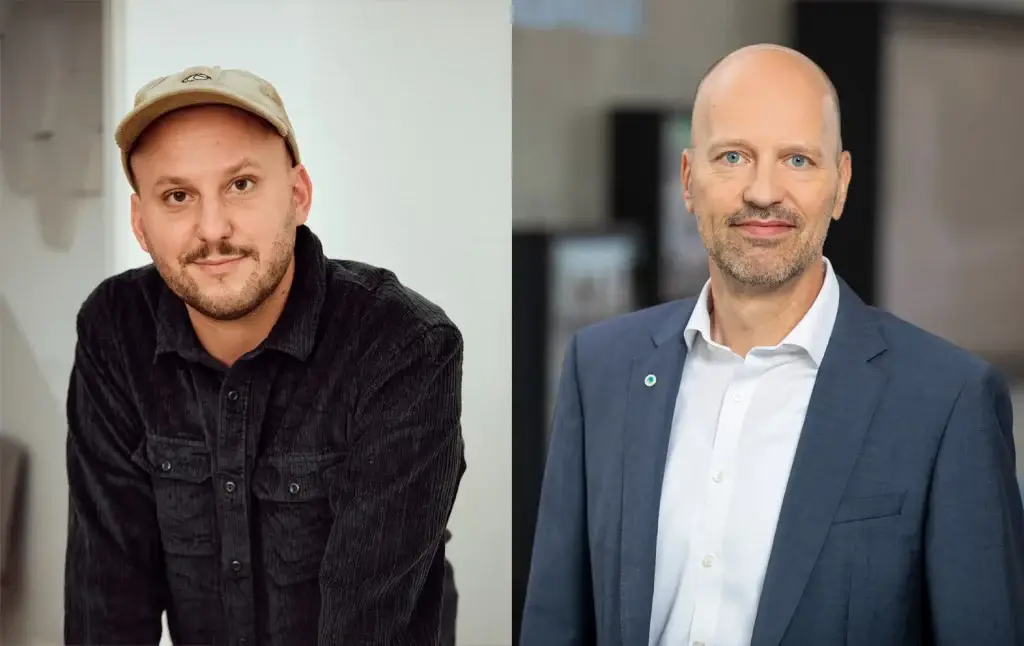
What is the goal of the partnership between muffintech and Bayerische – and what do you want to achieve together?
Simon Moser:"We believe that GenAI will make it much easier to access insurance, especially for a younger, urban audience. Bayerische is technologically open, digitally strong, and appeals to precisely these target groups. For us, this results in a partnership that allows us to break new ground and remove real barriers."
Joachim Zech:"And this is precisely where we come in: our goal is to make insurance simpler, more transparent, and more intuitive. muffintech brings technological excellence to the table, while we bring a deep understanding of our customers. Together, we develop solutions that are supported by AI, but with a clear focus on comprehensibility and trust."
The hint came from you yourselves: the connection already existed before ITHM. How did the ITHM Venture Client Program influence or accelerate the collaboration nonetheless?
Joachim Zech: "ITHM has taken the partnership to the next level. The program has not only given us greater visibility, but also provided us with valuable sparring partners and inspiration from the ecosystem. Being close to other innovative minds acts as a catalyst. It accelerates ideas, strengthens exchange, and creates space to boldly push projects forward."
Simon Moser: "That's exactly how it was: thanks to ITHM, we had many more touchpoints. We were able to talk directly with teams on site, develop ideas further, and speed up decisions. This made the existing exchange much more intensive and faster."
LEA is your joint pilot project. What exactly makes the AI assistant special—and why are you launching it in the field of supplementary dental insurance?
Joachim Zech: "LEA stands for 'Liefert. Einfach. Antworten.' (Delivers. Simply. Answers.) – and that's exactly what it does. The AI assistant guides interested parties step by step through the application process, answers questions directly and comprehensively, and ensures that customers know what to do at all times.
We deliberately chose supplementary dental insurance because it is an ideal starting point: a clearly defined product, yet with a relatively high need for advice and a target group that is accustomed to digital interaction. This allows us to measure impact and user behavior very accurately."
Simon Moser: "And LEA is deliberately not a 'sales bot' designed to persuade people to make a purchase, but rather supports people by answering relevant questions. Whether product-related or process-related. Dental insurance is an ideal starting point, as it is a popular online product, but one that is complex enough that people still have questions.
The technology is based on certified insurance knowledge. Why was this depth of content particularly important to you?
Joachim Zech: "Because trust is the foundation of our business. People rightly expect to encounter reliable knowledge in digital processes, especially in a regulated environment such as the insurance industry. LEA provides the right answers. The combination of verified content, explainable AI, and a clear regulatory framework creates security. Both for our customers and for our sales partners."
What distinguishes LEA from other digital assistants or chatbots currently on the market?
Joachim Zech: "LEA thinks in conversations. It understands context, recognizes needs, and actively guides users to the right solution for them. It's more than just a chatbot. It's a true digital companion in the decision-making process. The key point here is that LEA was designed from the outset with a clear focus on sales support. It is intended to help people make good decisions and enable our sales partners to provide more efficient advice."
Simon Moser: "What's more, Lea not only has certified insurance knowledge, but also embodies the voice and tone of Bayerische. She is not a generic chatbot, but a digital assistant available 24/7."
First phase: dental insurance, soon to be followed by household contents insurance – what have you learned from the project so far?
SM: "We see very clearly that people use AI particularly when they still have questions in the final stages. This is the case, for example, in the final stages before closing a deal – in the closing phase. This is where LEA is used a lot and helps by answering questions relevant to closing the deal. We analyze these learnings and incorporate them into the next product worlds."
Joachim Zech: "And we've noticed that when the benefits are immediately apparent, acceptance increases. People appreciate clear explanations and simple wording. At the same time, we've learned how important balance is. AI should provide support, but not overwhelm. These insights are now being incorporated into the next product areas."
What vision are you pursuing together with LEA—and what are the next steps?
Simon Moser: "For us, LEA should make Bayerische the benchmark for user experience and customer centricity. AI is not an end in itself, but a way to meaningfully accompany people throughout their entire journey."
Joachim Zech: "We want to make insurance something you can experience, not just something you can take out. The next step is to expand to other products, in particular home contents insurance. In the long term, we can imagine LEA as a universal companion throughout the entire customer journey, from information to purchase to service."
What does this partnership mean for you—even beyond the project? What do startups need to be able to work successfully with insurers?
Joachim Zech: "This partnership shows how much can be achieved when two worlds openly engage with each other. For us at Bayerische, one thing is clear: innovation arises when people take responsibility together. For us, muffintech is an example of how technology and insurance expertise can go hand in hand."
Simon Moser:"Startups need partners who make decisions, try things out, and don't get stuck in endless loops. That's exactly what we've experienced here: openness, speed, and a clear desire to put customers first."