[vc_row][vc_column][vc_column_text]
Many consumers want a so-called "financial home" - a central platform through which they can manage all their personal financial matters. The InsurTech Hub Munich (ITHM), together with its partner network of insurance companies, start-ups, IT service providers and the strategy consultancy Oliver Wyman, worked out what such a platform could look like in concrete terms as part of the FIN:SURE innovation program, which lasted several weeks. in addition to a new distribution of roles and cooperation between insurers, banks, neo-brokers, neo-banks and start-ups, the individual and changed customer approach plays a central role in the financial home. This is a key finding from the development and testing of the ITHM prototype. In order to take advantage of the growth opportunities in the emerging market for complete offers, insurers in particular should use their opportunities to establish such all-round carefree offers for private provision and finance and thus strengthen and expand their sales channels. In addition to investments in technology, this requires a broader restructuring of sales organizations.
Private financial matters are a mess in many households, with numerous service providers vying for access and customer loyalty at the same time. A typical scenario: a branch bank manages the salary account, an online bank manages the share portfolio. An insurer also supports asset accumulation, while a payment service provider handles money transfers for online shopping and a smartphone app promises an overall view of finances. "The situation is anything but clear for consumers, and the risk of unnecessary costs and bad financial decisions is growing," says Dietmar Kottmann, Partner at strategy consultancy Oliver Wyman.
Higher-level platforms could ensure order in personal money matters. However, it is not clear who will act as the provider of these meta-portals. Banks and insurance companies are competing with neo-brokers and neo-banks that are aggressively pushing into the market. The decisive factor for the success of such financial home platforms will be customer approach and trust. This fact opens up market potential for traditional insurance companies - they have long-term customer loyalty and the necessary trust, but often do not have the desired flexibility to meet the individual wishes of consumers. These are the key findings from over 30 detailed customer interviews and tests on the ITHM financial home prototype that was built. "Our analyses have clearly shown that customers want to be segmented and serviced differently in the future. They no longer want the classic distinctions and standard offers based on income, age and education, but rather the integration of life goals, wishes and individual events," explains Esther Prax, Program Director at ITHM. "Above all, transparent and comprehensible cost structures for advice and products are the focus of the needs. Individual elements and offers already exist on the market, for example from international start-ups. However, there is no end-to-end platform that covers customer behavior in all areas," adds Prax.
New platforms will establish themselves successfully if they not only offer central access to personal finances, but also manage and optimize them comprehensively. A race for this lucrative meta-function has already begun. According to Prax, insurers are in a good starting position to score points with customers with an all-round carefree offering. "The starting position is not bad for insurers because protecting and increasing assets is one of their core competencies - with decades of experience."
Considerable demand from European consumers
In a survey conducted in Germany, Italy, France, the UK and Spain, Oliver Wyman found that a significant proportion of consumers would like to have a financial home. On average, 33 percent of those surveyed showed an interest in it. In strong bancassurance markets such as France, Italy and Spain, even higher approval ratings were achieved. Consumers there are already more accustomed to financial and insurance products from a single source. In Germany, approval reached 26 percent. "This means there is considerable growth potential for providers," says Kottmann, who is responsible for the insurance consulting business in Germany, Austria and Switzerland at Oliver Wyman. He expects approval ratings to continue to rise.
"We expect the development of financial home solutions to pick up speed over the next decade," says Kottmann. "Early positioning will give us a head start when the financial home trend gains momentum." As the sales structures of individual insurers differ, the path to becoming a financial home provider also varies from company to company. "If you want to exploit the potential of the financial home, you have to find an individual strategy," says Kottmann.
Digital private banker as a vision for the future
The diversity of approaches is demonstrated by a look at the German financial and insurance market: providers such as Swiss Life Select or MLP are already striving for a holistic financial consulting approach with their analogue sales organizations and are demonstrating that bancassurance is in demand with their growth, which is well above the market average. Similarly, platforms such as Check24 or direct insurers such as HUK24 are setting the pace with more digital approaches and demonstrating the growth potential they offer. The business model for the financial home will not initially be a purely digital one, says Kottmann. According to the analysis, companies must convince their brokers and agents to go beyond the pure insurance offering and credibly position the broader offering to their customers. "The industry is not facing a technology problem, but a transformation problem," says Kottmann. The broader positioning can be achieved by hiring additional sales staff with financial expertise. Remote specialists at the head office could also help local sales staff to bring the necessary expertise to the advisory process when it comes to questions about more complicated financial products or special topics such as inheritance.
The experts at Oliver Wyman see the private bank as a model for the financial home. "They should represent the interests of their clients and have the breadth of specialists to cover all life situations," says Kottmann. However, private banks only serve a small target group of wealthy individuals. "A digital, automated private banker as a synonym for a financial home could enable everyone to afford such a service in the long term." It makes sense for insurers to change course now. "Insurers should consider whether they should start building a path into this future world - with ever more comprehensive offerings, including financial services," says Kottmann. "The traditional players will have to act more flexibly here and expand their core competencies in future with expertise partners from the entire ecosystem," adds Prax. Competitive pressure will increase. "All players in the market have the opportunity to take the step towards the financial home."
Further information in the full press release.
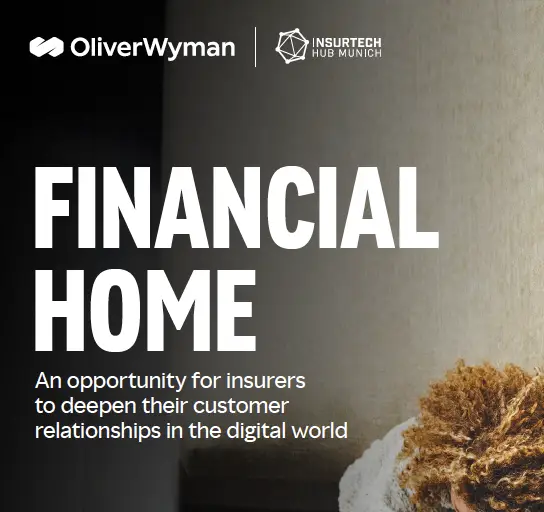
Download the full report "Financial Home". The report contains market trends and a selection of FIN:SURE insights, compiled from the ecosystem of insurance companies, IT service providers, banks and start-ups.
[/vc_column_text][/vc_column][/vc_row]